
 1 hour ago
2
1 hour ago
2
Alice CuddySenior international reporter, Beirut

 EPA
EPA
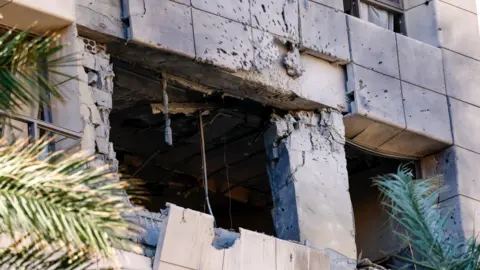
The Ramada Plaza hotel in Beirut was damaged following an Israeli strike on 8 March
It was about 01:30 in the morning when a loud explosion tore through the Raouche neighbourhood in the heart of the Lebanese capital Beirut.
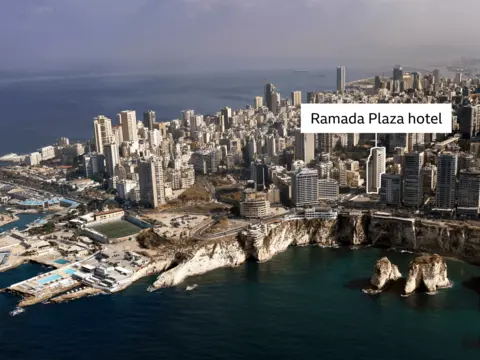
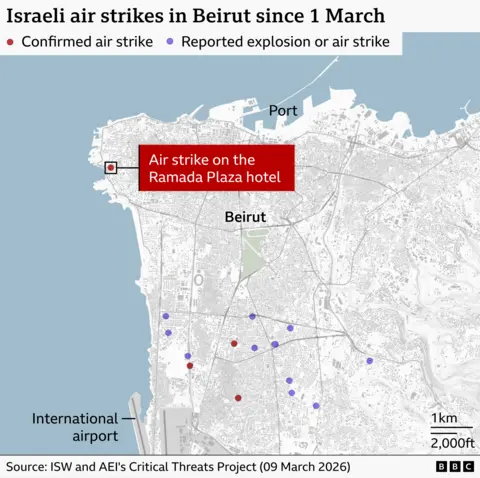
The Israeli strike on the four-star Ramada Plaza hotel marked the first time in this war that Israel's bombing campaign had struck the city centre - a bustling coastal area full of restaurants and hotels.
Inside, the Israeli military said, was a secret meeting of Iranian operatives - an allegation that has now been denied by Iran's government.
The strike came without warning, and locals and displaced people staying in the area ran to their windows and balconies to see what had happened. Those on the streets nearby - still busy with Ramadan crowds - ducked for cover.
Lebanon has been hit with hundreds of Israeli strikes since war between Israel and the Iran-backed armed group and political movement Hezbollah resumed here a week ago. Many of the strikes have toppled entire buildings, and nearly 500 people have been killed, according to official figures.
They have focused on southern Lebanon, the eastern Bekaa Valley, and the southern suburbs of Beirut - the heartlands of Hezbollah and of the country's Shia Muslim community.
But this Israeli drone strike in Raouche was far from there - instead targeting the fourth floor of the high-rise hotel, described on listings as offering "celebrity treatment with world-class service".
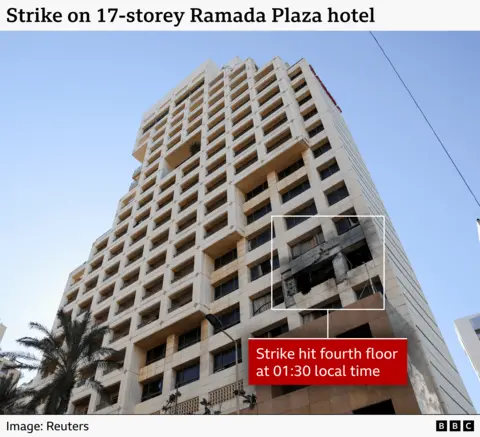
An initial toll by the Lebanese health ministry said four people had been killed and 10 injured in the strike, but it did not identify them.
The Israel Defense Forces (IDF) said the five men killed in the strike worked for Iran's elite Quds Force - the overseas operations arm of the Islamic Revolutionary Guard Corps (IRGC).
They included a senior money man who would transfer funds to Hezbollah, and commanders specialised in intelligence gathering, it said.
Iran did not comment until Tuesday evening, when its mission to the UN in New York published a letter accusing Israel of what it called "the cowardly terrorist assassination of four diplomats of the Islamic Republic of Iran".
Hezbollah would not comment on the strike or its targets.
While the strike hit only a small area of the sprawling hotel, bystanders were among those injured and fear spread through the local community, as people reckoned with the war reaching their neighbourhood.
"This is not an area where you expect something like this to happen… of course we're scared," 47-year-old Yahya said while waiting for his coffee at the local Starbucks on Monday.
"I come outside for my sanity but it's scary - you don't know who's standing next to you or in a building next to you. In the bombings they often give warnings but in the assassinations they don't, and the Israelis don't care about bystanders."
Yahya said he could rarely hear the strikes that hit Beirut's southern neighbourhoods from his coastal apartment, but on Sunday morning the sound of the explosion jolted him from his sleep as it rang through homes and businesses across Raouche, shaking windows and shattering glass.
 EPA
EPA
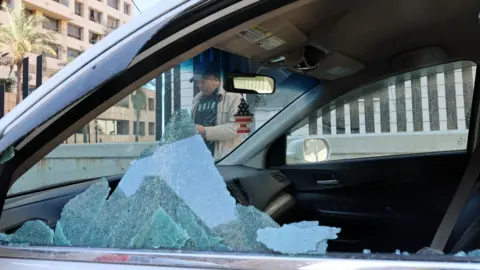
Cars parked near the hotel were damaged by the shockwave from the explosion
At the car park beneath it, 33-year-old Mousa Khodour was at work in a coffee kiosk.
He hadn't paid much attention to the hum of an Israeli drone overhead, which has become a common sound in Lebanon, but hit the ground when the explosion boomed.
"It was huge. The entire area shook," he said. "I also have my four kids sleeping over there [in a makeshift structure at the edge of the car park], so I ran to check on them and thank God they weren't wounded. They were crying."
While his children were unscathed, his cousin - also called Mousa - was injured by the shrapnel that sprayed across the car park.
The 30-year-old spoke to the BBC shortly after being discharged from hospital on Monday evening. He said a piece of shrapnel "the size of a chickpea" had torn through his leg.
"I just remember the bang and the glass coming down. It was very painful," the Syrian national said.
He fled to Lebanon in 2013 to escape the war in his home country, but said he no longer felt safe.
"We expected this to happen anywhere except for Raouche," he said. "Thank God it was my leg, not somewhere else."
 AFP via Getty Images
Others in Raouche, though, were less shocked.
The luxury hotels in the area that would usually accommodate tourists and businesspeople are now largely housing families who have been forced to flee from their homes because of sweeping Israeli evacuation orders warning of military action.
The United Nations estimates that nearly 700,000 people in Lebanon have been displaced by the renewed hostilities between Israel and Hezbollah, which began after Hezbollah fired rockets into Israel in response to the killing of Iran's supreme leader at the start of the war with Israel and the US.
Israel had continued near-daily strikes against the group across Lebanon after a ceasefire ended a war between them in November 2024.
Many of the current displaced people hail from Beirut's southern suburbs and have headed further north into the capital in search of shelter and safety.
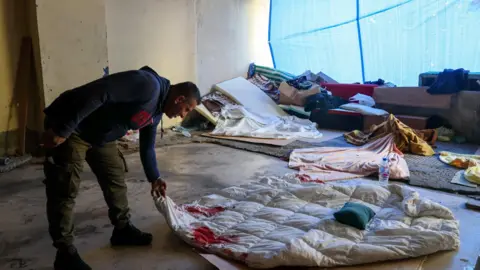
One displaced woman who was staying at the Ramada with her children said smoke had filled their room after the strike and the family had escaped down the emergency staircase.
Standing near shattered glass on the road near the hotel, a 47-year-old man displaced from Tyre in southern Lebanon stuck plastic bags across his car's blown out windscreen.
"We've been through a lot so we're used to it… we're not scared," he said, as his son nodded enthusiastically beside him. "They are saying it was Iranians but we don't know."
Above him, beyond the blackened, blown-out walls of the corner room on the hotel's fourth floor, police and military officials could be seen scouring the scene days after the strike.
 EPA
EPA
A displaced man staying in a garage near the hotel said his children were injured by shrapnel
Hotel management said they could not comment.
But one staff member told the BBC that the third and fourth floors had been blocked off for the police investigation, with the displaced people staying on them moved elsewhere. He said the hotel was large and busy, and he and his work friends did not know who had been staying in the specific room that was hit, but had heard the reports.
An official source told the BBC that three Lebanese nationals had booked rooms on the hotel's third and fourth floors which were used by the men targeted in the strike.
The source said the hotel was hit three times, but two of the munitions did not explode.
In its statement, the IDF said the strike, conducted by its navy, followed "precise IDF intelligence" that senior Quds Force officials - from its Lebanon Corps and Palestine Corps - were "hiding in a civilian hotel".
It named three "key commanders" it said were killed in the strike as Majid Hassani, described as being "responsible for transferring funds to the [Iranian] regime's proxies in Lebanon", and senior intelligence figures Alireza Bi-Azar and Ahmad Rasouli.
Two other Quds Force figures, Hossein Ahmadlou and Abu Mohammad Ali, were also killed, it said.
The IDF said the men's "elimination constitutes a significant and necessary blow to the Iranian presence in Lebanon and to the Hezbollah terrorist organisation".
In a letter to UN's secretary general sent on Thursday, Iran's permanent representative Amir-Saeid Iravani confirmed that Hassani, Bi-Azar, Rasouli and Ahmadlou were killed.
However, he identified them as the Iranian embassy in Beirut's second secretary, third secretary, attaché, and a person assigned to the mission, and condemned the strike as a "heinous crime".
"The targeting killing of four Iranian diplomats while they were serving as official representatives of a sovereign member state on the territory of another sovereign state constitutes a grave terrorist act and a serious breach of international law," Iravani wrote.
The strike in Raouche - the second to target a Beirut hotel in the past week - followed warnings from the Israeli military for Iranian government representatives in Lebanon to "leave immediately before they are targeted".
Lebanon's Prime Minister Nawaf Salam asked authorities last week to arrest and deport any Iranian Revolutionary Guards carrying out military activities in the country.
A senior Lebanese security source told Reuters news agency on Saturday that more than 150 Iranian nationals, including diplomats and their families, had left Lebanon after the Israeli military threat.
Iravani said Hassani, Bi-Azar, Rasouli and Ahmadlou had temporarily relocated from their official residences to the Ramada Plaza in response to the threat, and that the Lebanese foreign ministry had been notified.
In its statement after the Raouche strike, the IDF said it would "not allow the Iranian terror regime elements to establish themselves in Lebanon and will continue to precisely eliminate the commanders of the Iranian terror regime wherever they operate".
 EPA
EPA
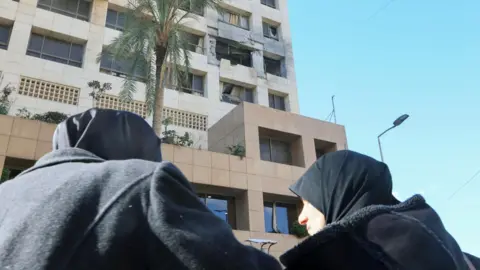
There was an uneasy normality on the streets outside the hotel this week
In Raouche this week, there was an uneasy normality on the streets outside the hotel, with passers-by peering up at the damage as they drove past on the busy road.
Displaced barber Mohamed Abbas said he had been close to four strikes in southern Lebanon last week before fleeing to Raouche, hoping it would be safer.
"There is no safe place in Lebanon and what happened is proof that Israel doesn't have red lines - they strike, attack and kill wherever they want," he said.
For some of those displaced to the area, the strike signalled that they could not escape the war.
"My house in the south was destroyed in the previous war, and my house in Dahieh [in southern Beirut] was destroyed in this war," a 23-year-old man standing beneath the Ramada Plaza said.
"The war is expanding more and more."
Additional reporting by Angie Mrad




 English (US) ·