
 2 hours ago
1
2 hours ago
1
Lucy HookerBusiness reporter, Bank of England

 Getty Images
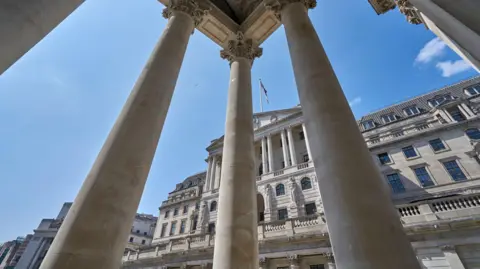
The Bank of England "stands ready to act" to keep interest rates at a level that will keep inflation under control, its governor Andrew Bailey has said.
His comments came as the Bank announced it was leaving its key rate unchanged at 3.75%. Until the conflict in the Middle East began a rate cut had been expected.
The Bank said prices would rise more quickly due to the "new shock to the economy". It now expects inflation to be close to 3.5% in March.
Unusually, all nine members of the rate-setting committee backed the decision to hold rates and "assess how events unfold", and discussed whether a rate rise could be needed.
Before the US-Israel attack on Iran, economists had expected inflation and interest rates to fall further this year.
Some had pencilled in a rate cut for March. But the committee decided to hold, in the first unanimous vote since September 2021.
The conflict has pushed up the price of oil and gas sharply, with attacks on energy infrastructure in the last 24 hours adding further upward pressure. That has raised the prospect of another pick-up in inflation as energy price rises push fuel, fertiliser and other prices higher.
"War in the Middle East has pushed up energy prices. You can already see that at the petrol pump and, if it lasts, it will feed into higher household energy bills later in the year," said Bailey.
The only way to address higher energy prices was by restoring safe passage for shipping in the Gulf, he said.
But he emphasised the focus of the Bank's Monetary Policy Committee (MPC) was on the wider knock-on impact on prices.
"Whatever happens, our job is to make sure inflation gets back to its 2% target," said Bailey. Inflation in January stood at 3%.
The language at recent meetings of the MPC has centred around a reduction in borrowing costs. At February's meeting members were split, with four backing a cut and five, including the Bank's governor, voting to hold rates steady.
Notes from this meeting showed the debate has been turned on its head, with the committee backing a hold in rates.
They also discussed whether a rate rise could be required in the coming months, something which financial markets now think could be the next move.
Following the Bank's latest decision and comments, traders are predicting there could be two hikes before the end of the year, taking rates to 4.25%.
"Rate hikes are now a real risk for the economy," said Deutsche Bank's UK chief economist Sanjay Raja.
"Should energy prices stick at current levels, the MPC could be forced into pushing rates higher to curb inflation."
The change in expectations over the future path of interest rates has already had an impact on the mortgage market.
Over the past few weeks, rates on new fixed deals have risen sharply and hundreds of mortgage products have been withdrawn by lenders.
 Supplied
Henry says he will have to change his lifestyle due to cost-of-living pressures
First-time buyer Henry is feeling relieved after locking in a five-year deal last week.
He'd moved back home with his mum in Lincolnshire while saving for his deposit and had been holding out for better interest rates.
Henry says he wanted to act now rather than risk the prospect of even higher rates in the coming weeks. "I thought I need to get this sorted."
He says rising cost-of-living pressures are also on his mind. "I am going to have to have a lifestyle change, admittedly."
Uncertainty over how long the Middle East conflict might last, and what the longer term impact on energy prices might be, has also led other central banks to hit the pause button on rate moves.
The US central bank said on Wednesday that borrowing rates would remain in the 3.5% to 3.75% window, and the European Central Bank held rates at 2% on Thursday.
The wave of price rises that followed Russia's invasion of Ukraine has cast a long shadow over central banks' decision making. Rate setters on both sides of the Atlantic were criticised for acting too slowly. As a result, they are expected to exercise extra vigilance this time round.
Bailey said uncertainty over the duration of the disruptions remained but the Bank would have to respond to "the risk of a more persistent effect" on prices.
Households and businesses would be "more sensitive" to any new pick-up in inflation, he said.
"I will be monitoring developments extremely closely and stand ready to act as necessary to ensure that inflation remains on track to meet the 2% target in the medium term," Bailey said.
The Bank made clear that the discussion covered a "range of possibilities" for the future path of rates.
"A larger or more protracted shock" from the Middle East conflict would require "a more restrictive policy stance", it said. But policy would be eased if the shock was "very short-lived" or if inflationary pressures were falling due to slack in the economy.
The next rate-setting meeting is scheduled for April, although the Bank can call emergency meetings if it considers it necessary.
Additional reporting by Adam Woods




 English (US) ·